Async Coaching
Async Coaching vs Live Coaching: Which One When?
Live coaching is personal but capped by your calendar. Async coaching scales the same human method without live calls. Here is an honest comparison, and how to decide which to use.
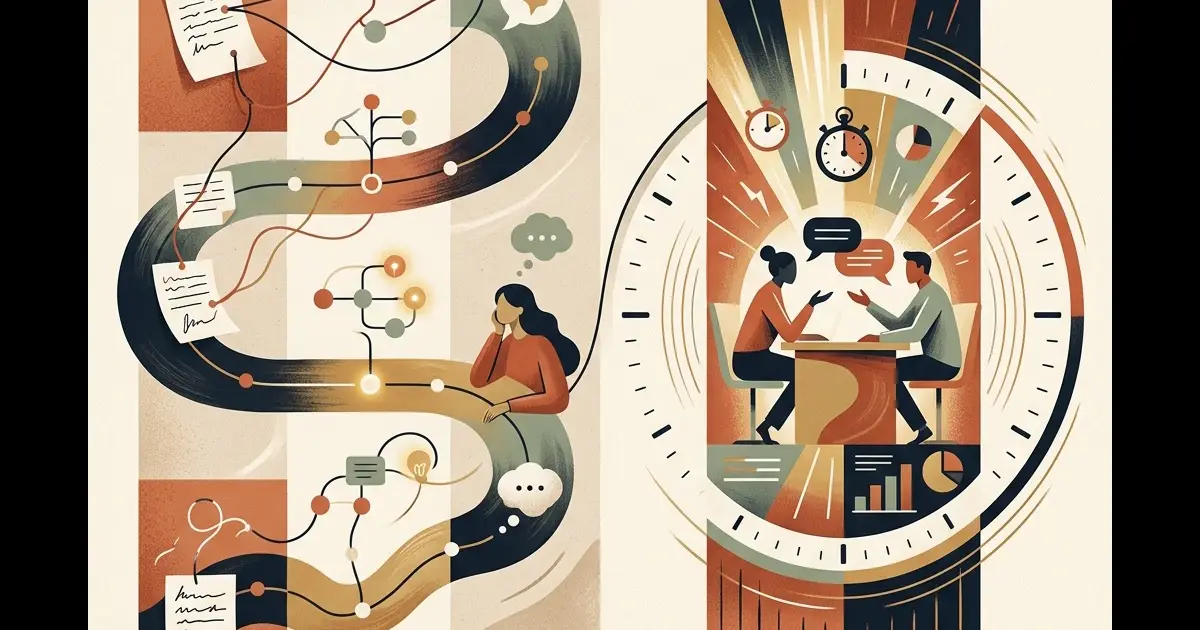
Async coaching and live coaching are not rivals so much as two delivery formats for the same thing: a human method applied to a specific person. Live coaching does it in real time, on a call. Async coaching does it through time-shifted check-ins and personalized sessions, with no call required.
If you want the one-line decision rule: use live for the moments that genuinely need real-time presence, and async for everything else, which is usually most of it.
The honest comparison
| Live coaching | Async coaching | |
|---|---|---|
| Personalization | High | High |
| Scales beyond your calendar | No | Yes |
| Time-zone friction | High | None |
| Client reflection quality | Variable, on the spot | Often deeper, prepared |
| Best for in-the-moment work | Yes | Limited |
| Income capped by your hours | Yes | No |
Live coaching’s strength is presence: you can read the room, follow a thread as it unfolds, and respond to something the client did not plan to say. Its weakness is structural: your income is capped by the hours in your week, time zones create friction, and your best energy gets sliced into calendar blocks.
Async coaching inverts that trade. You lose real-time presence but gain reach, time, and, often, depth. (For the full mechanics, see what async coaching is.)
Why async often goes deeper
This surprises people. A live call begins with a performance problem: the client has to explain themselves in real time, sound clearer than they feel, and often avoid the uncomfortable part. Async changes the rhythm. Before each session the client reflects and answers a few focused questions, in writing or by voice, on their own terms. The signal you get back is frequently better than what surfaces in the first ten minutes of a call. The craft is in how you design that check-in.
Where live still wins
Async is not a universal replacement. Keep live for a first sensitive intervention, a crisis, a hard relational conversation, or a high-stakes decision where nuance and immediacy matter. The point is not to eliminate live time but to stop spending it on the parts of coaching that never needed it.
How to decide
Ask one question of each part of your offer: does this moment need real-time presence, or does it just feel normal to do it live? Onboarding, between-session work, homework review, accountability, and most reflection do not need real time. Move those to async, keep the rest live, and you get a practice that scales without losing the human method. This is the same logic behind scaling coaching without more Zoom calls.
Most coaches who try this end up async-first, with a thin layer of live sessions on top, rather than the other way around.
Frequently asked questions
Is async coaching as effective as live coaching? +
For most structured coaching work, yes, and sometimes more. Much of a live call is reporting, reflecting, and setting the next step, which does not need real time. Clients often reflect more honestly when they are not on camera. Live still wins for sensitive, in-the-moment work.
Can I combine async and live coaching? +
Yes, and many coaches do. A common model is async for intake, between-session work, and accountability, with a small number of live sessions reserved for the moments that genuinely need real-time presence.
Does async coaching mean slower responses? +
Not necessarily. A personalized async session can be prepared in minutes, so the client often gets a tailored response faster than waiting days for the next available live slot.